A whitelist or allowlist is a list or register of entities that are being provided a particular privilege, service, mobility, access or recognition. Entities on the list will be accepted, approved and/or recognized. Whitelisting is the reverse of blacklisting, the practice of identifying entities that are denied, unrecognized, or ostracized. == Email whitelists == Spam filters often include the ability to "whitelist" certain sender IP addresses, email addresses or domain names to protect their email from being rejected or sent to a junk mail folder. These can be manually maintained by the user or system administrator - but can also refer to externally maintained whitelist services. === Non-commercial whitelists === Non-commercial whitelists are operated by various non-profit organizations, ISPs, and others interested in blocking spam. Rather than paying fees, the sender must pass a series of tests; for example, their email server must not be an open relay and have a static IP address. The operator of the whitelist may remove a server from the list if complaints are received. === Commercial whitelists === Commercial whitelists are a system by which an Internet service provider allows someone to bypass spam filters when sending email messages to its subscribers, in return for a pre-paid fee, either an annual or a per-message fee. A sender can then be more confident that their messages have reached recipients without being blocked, or having links or images stripped out of them, by spam filters. The purpose of commercial whitelists is to allow companies to reliably reach their customers by email. == Advertising whitelist == Many websites rely on ads as a source of revenue, but the use of ad blockers is increasingly common. Websites that detect an adblocker in use often ask for it to be disabled - or their site to be "added to the whitelist" - a standard feature of most adblockers. == Network whitelists == === LAN whitelists === A use for whitelists is in local area network (LAN) security. Many network admins set up MAC address whitelists, or a MAC address filter, to control who is allowed on their networks. This is used when encryption is not a practical solution or in tandem with encryption. However, it's sometimes ineffective because a MAC address can be faked. === IP whitelist === Firewalls can usually be configured to only allow data-traffic from/to certain (ranges of) IP-addresses. === Application whitelists === One approach in combating viruses and malware is to whitelist software which is considered safe to run, blocking all others. This is particularly attractive in a corporate environment, where there are typically already restrictions on what software is approved. Leading providers of application whitelisting technology include Bit9, Velox, McAfee, Lumension, ThreatLocker, Airlock Digital and SMAC. On Microsoft Windows, recent versions include AppLocker, which allows administrators to control which executable files are denied or allowed to execute. With AppLocker, administrators are able to create rules based on file names, publishers or file location that will allow certain files to execute. Rules can apply to individuals or groups. Policies are used to group users into different enforcement levels. For example, some users can be added to a report-only policy that will allow administrators to understand the impact before moving that user to a higher enforcement level. Linux systems typically have AppArmor and SE Linux features available which can be used to effectively block all applications which are not explicitly whitelisted, and commercial products are also available. On HP-UX introduced a feature called "HP-UX Whitelisting" on 11iv3 version. == Controversy regarding name == In 2018, a journal commentary on a report on predatory publishing was released making claims that "white" and "black" are racially charged terms that need to be avoided in instances such as "whitelist" and "blacklist". The premise of the journal is that "black" and "white" have negative and positive connotations respectively. It states that since "blacklisting" was first referred to during "the time of mass enslavement and forced deportation of Africans to work in European-held colonies in the Americas," the word is therefore related to race. There is no mention of "whitelist" and its origin or relation to race. This issue is most widely disputed in computing industries where "whitelist" and "blacklist" are prevalent (e.g. IP whitelisting). Despite the commentary nature of the journal, some companies and individuals in others have taken to replacing "whitelist" and "blacklist" with new alternatives such as "allow list" and "deny list". Those adopting this change consider using the "whitelist"/"blacklist" names as a code smell. Those that oppose these changes question its attribution to race, citing the same etymology quote that the 2018 journal uses. According to the remark, the term "blacklist" evolved from the term "black book" about a century ago. The term "black book" does not appear to have any etymology or sources that support racial associations, instead originating in the 1400s as a reference to "a list of people who had committed crimes or fallen out of favor with leaders", and popularized by King Henry VIII's literal use of a black book. Others also note the prevalence of positive and negative connotations to "white" and "black" in the Bible, predating attributions to skin tone and slavery. It wasn't until the 1960s Black Power movement that "Black" became a widespread word to refer to one's race as a person of color in America (alternate to African-American) lending itself to the argument that the negative connotation behind "black" and "blacklist" both predate attribution to race.
Glossary of robotics
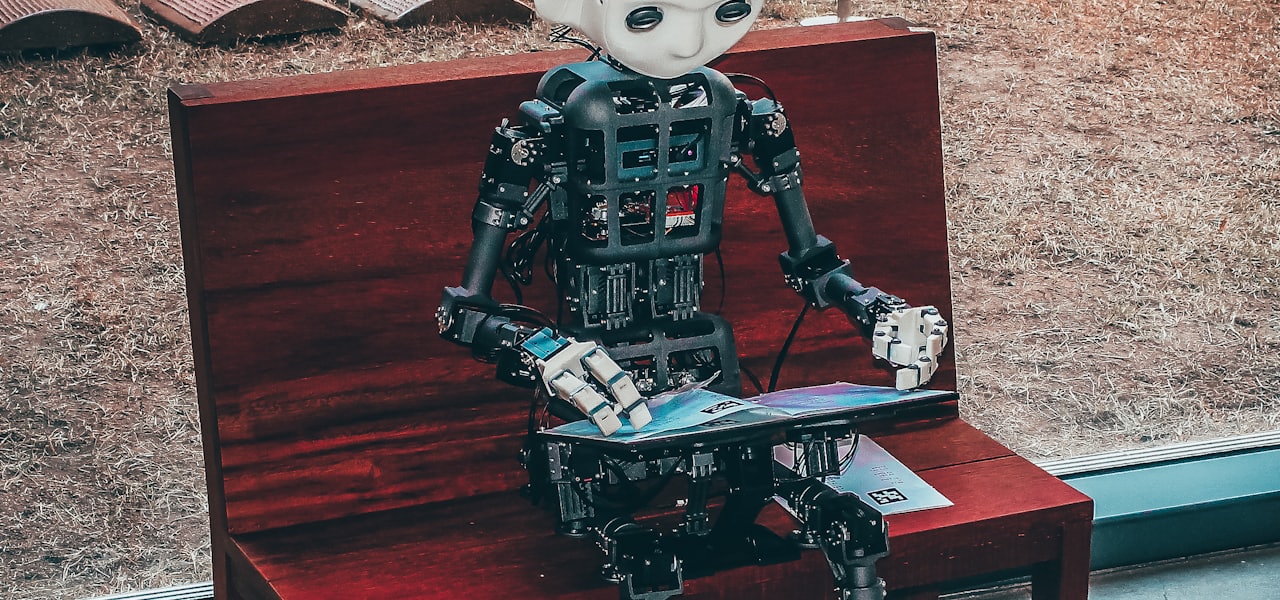
Robotics is the branch of technology that deals with the design, construction, operation, structural disposition, manufacture and application of robots. Robotics is related to the sciences of electronics, engineering, mechanics, and software. The following is a list of common definitions related to the Robotics field. == A == Actuator: a motor that translates control signals into mechanical movement. The control signals are usually electrical but may, more rarely, be pneumatic or hydraulic. The power supply may likewise be any of these. It is common for electrical control to be used to modulate a high-power pneumatic or hydraulic motor. Aerobot: a robot capable of independent flight on other planets. A type of aerial robot. Arduino: The current platform of choice for small-scale robotic experimentation and physical computing. Artificial intelligence: is the intelligence of machines and the branch of computer science that aims to create it. Aura (satellite): a robotic spacecraft launched by NASA in 2004 which collects atmospheric data from Earth. Automaton: an early self-operating robot, performing exactly the same actions, over and over. Autonomous vehicle: a vehicle equipped with an autopilot system, which is capable of driving from one point to another without input from a human operator. == B == Biomimetic: See Bionics. Bionics: also known as biomimetics, biognosis, biomimicry, or bionical creativity engineering is the application of biological methods and systems found in nature to the study and design of engineering systems and modern technology. == C == CAD/CAM (computer-aided design and computer-aided manufacturing): These systems and their data may be integrated into robotic operations. Čapek, Karel: Czech author who coined the term 'robot' in his 1921 play, Rossum's Universal Robots. Chandra X-ray Observatory: a robotic spacecraft launched by NASA in 1999 to collect astronomical data. Cloud robotics: robots empowered with more capacity and intelligence from cloud. Combat, robot: a hobby or sport event where two or more robots fight in an arena to disable each other. This has developed from a hobby in the 1990s to several TV series worldwide. Cruise missile: a robot-controlled guided missile that carries an explosive payload. Cyborg: also known as a cybernetic organism, a being with both biological and artificial (e.g. electronic, mechanical or robotic) parts. == D == Degrees of freedom: the extent to which a robot can move itself; expressed in terms of Cartesian coordinates (x, y, and z) and angular movements (yaw, pitch, and roll). Delta robot: a tripod linkage, used to construct fast-acting manipulators with a wide range of movement. Drive Power: The energy source or sources for the robot actuators. == E == Emergent behaviour, a complicated resultant behaviour that emerges from the repeated operation of simple underlying behaviours. Envelope (Space), Maximum The volume of space encompassing the maximum designed movements of all robot parts including the end-effector, workpiece, and attachments. Explosive ordnance disposal robot A mobile robot designed to assess whether an object contains explosives; some carry detonators that can be deposited at the object and activated after the robot withdraws. == F == FIRST(For Inspiration and Recognition of Science and Technology): an organization founded by inventor Dean Kamen in 1989 in order to develop ways to inspire students in engineering and technology fields. Forward chaining: a process in which events or received data are considered by an entity to intelligently adapt its behavior. == G == Gynoid: A humanoid robot designed to look like a human female. == H == Haptic: tactile feedback technology using the operator's sense of touch. Also sometimes applied to robot manipulators with their own touch sensitivity. Hexapod (platform): A movable platform using six linear actuators. Often used in flight simulators and fairground rides, they also have applications as a robotic manipulator. Hexapod (walker): A six-legged walking robot, using a simple insect-like locomotion. Human–computer interaction. Humanoid: A robotic entity designed to resemble a human being in form, function, or both. Hydraulics: the control of mechanical force and movement, generated by the application of liquid under pressure. cf. pneumatics. == I == Industrial robot: A reprogrammable, multifunctional manipulator designed to move material, parts, tools, or specialized devices through variable programmed motions for the performance of a variety of tasks. Insect robot: A small robot designed to imitate insect behaviors rather than complex human behaviors. == K == Kalman filter: a mathematical technique to estimate the value of a sensor measurement, from a series of intermittent and noisy values. Kinematics: the study of motion, as applied to robots. This includes both the design of linkages to perform motion, their power, control and stability; also their planning, such as choosing a sequence of movements to achieve a broader task. Inverse Kinematics: the process of determining joint angles required for a robot's end-effector to reach a desired position and orientation in space. Used in motion planning to calculate motor commands from target positions. == L == Linear actuator A form of motor that generates a linear movement directly. == M == Manipulator or gripper: A robotic 'hand'. Mobile robot: A self-propelled and self-contained robot that is capable of moving over a mechanically unconstrained course. Muting: The deactivation of a presence-sensing safeguarding device during a portion of the robot cycle. Mecanum wheel: A wheel fitted with angled rollers that enables a robot vehicle to move in multiple directions, including sideways. == O == Ornithopter – An aerial robot or drone that achieves flight through a flapping-wing mechanism rather than rotating blades or fixed wings, often utilized for highly maneuverable flight. == P == Parallel manipulator: an articulated robot or manipulator based on a number of kinematic chains, actuators and joints, in parallel. cf. serial manipulator. Pendant: Any portable control device that permits an operator to control the robot from within the restricted envelope (space) of the robot. Pneumatics: the control of mechanical force and movement, generated by the application of compressed gas. cf. hydraulics. Powered exoskeleton: is a wearable mobile machine that allow for limb movement with increased strength and endurance. Prosthetic robots: programmable manipulators or devices for missing human limbs. == R == Remote manipulator: A manipulator under direct human control, often used for work with hazardous materials. Robonaut: a development project conducted by NASA to create humanoid robots capable of using space tools and working in similar environments to suited astronauts. == S == Sensor fusion:The process of combining data from multiple sensors, such as LiDAR, cameras, global positioning systems (GPS), and inertial measurement units (IMUs), to produce a more accurate and reliable understanding of an environment than using a single sensor alone. It is widely used in robotics and autonomous systems to improve perception, localization, and decision-making. Serial manipulator: an articulated robot or manipulator with a single series kinematic chain of actuators. cf. parallel manipulator. Service robots are machines that extend human capabilities. Servo, a motor that moves to and maintains a set position under command, rather than continuously moving. Servomechanism An automatic device that uses error-sensing negative feedback to correct the performance of a mechanism. Single Point of Control The ability to operate the robot such that initiation or robot motion from one source of control is possible only from that source and cannot be overridden from another source. Slow Speed Control A mode of robot motion control where the velocity of the robot is limited to allow persons sufficient time either to withdraw the hazardous motion or stop the robot. Snake robot A robot component resembling a tentacle or elephant's trunk, where many small actuators are used to allow continuous curved motion of a robot component, with many degrees of freedom. This is usually applied to snake-arm robots, which use this as a flexible manipulator. A rarer application is the snakebot, where the entire robot is mobile and snake-like, so as to gain access through narrow spaces. Stepper motor Stewart platform A movable platform using six linear actuators, hence also known as a Hexapod. Subsumption architecture A robot architecture that uses a modular, bottom-up design beginning with the least complex behavioral tasks. Surgical robot, a remote manipulator used for keyhole surgery Swarm robotics involve large numbers of mostly simple physical robots. Their actions may seek to incorporate emergent behavior observed in social insects (swarm intelligence). Synchro == T == Teach Mode: The control state that al
Wetware (brain)
Wetware is a term drawn from the computer-related idea of hardware or software, but applied to biological life forms. == Usage == The prefix "wet" is a reference to the water found in living creatures. Wetware is used to describe the elements equivalent to hardware and software found in a person, especially the central nervous system (CNS) and the human mind. The term wetware finds use in works of fiction, in scholarly publications and in popularizations. The "hardware" component of wetware concerns the bioelectric and biochemical properties of the CNS, specifically the brain. If the sequence of impulses traveling across the various neurons are thought of symbolically as software, then the physical neurons would be the hardware. The amalgamated interaction of this software and hardware is manifested through continuously changing physical connections, and chemical and electrical influences that spread across the body. The process by which the mind and brain interact to produce the collection of experiences that we define as self-awareness is in question. == History == Although the exact definition has shifted over time, the term Wetware and its fundamental reference to "the physical mind" has been around at least since the mid-1950s. Mostly used in relatively obscure articles and papers, it was not until the heyday of cyberpunk, however, that the term found broad adoption. Among the first uses of the term in popular culture was the Bruce Sterling novel Schismatrix (1985) and the Michael Swanwick novel Vacuum Flowers (1987). Rudy Rucker references the term in a number of books, including one entitled Wetware (1988): ... all sparks and tastes and tangles, all its stimulus/response patterns – the whole bio-cybernetic software of mind. Rucker did not use the word to simply mean a brain, nor in the human-resources sense of employees. He used wetware to stand for the data found in any biological system, analogous perhaps to the firmware that is found in a ROM chip. In Rucker's sense, a seed, a plant graft, an embryo, or a biological virus are all wetware. DNA, the immune system, and the evolved neural architecture of the brain are further examples of wetware in this sense. Rucker describes his conception in a 1992 compendium The Mondo 2000 User's Guide to the New Edge, which he quotes in a 2007 blog entry. Early cyber-guru Arthur Kroker used the term in his blog. With the term getting traction in trendsetting publications, it became a buzzword in the early 1990s. In 1991, Dutch media theorist Geert Lovink organized the Wetware Convention in Amsterdam, which was supposed to be an antidote to the "out-of-body" experiments conducted in high-tech laboratories, such as experiments in virtual reality. Timothy Leary, in an appendix to Info-Psychology originally written in 1975–76 and published in 1989, used the term wetware, writing that "psychedelic neuro-transmitters were the hot new technology for booting-up the 'wetware' of the brain". Another common reference is: "Wetware has 7 plus or minus 2 temporary registers." The numerical allusion is to a classic 1957 article by George A. Miller, The magical number 7 plus or minus two: some limits in our capacity for processing information, which later gave way to Miller's law.
Intelligent agent
In artificial intelligence, an intelligent agent is an entity that perceives its environment, takes actions autonomously to achieve goals, and may improve its performance through machine learning or by acquiring knowledge. AI textbooks define artificial intelligence as the "study and design of intelligent agents," emphasizing that goal-directed behavior is central to intelligence. A specialized subset of intelligent agents, agentic AI (also known as an AI agent or simply agent), expands this concept by proactively pursuing goals, making decisions, and taking actions over extended periods. Intelligent agents can range from simple to highly complex. A basic thermostat or control system is considered an intelligent agent, as is a human being, or any other system that meets the same criteria—such as a firm, a state, or a biome. Intelligent agents operate based on an objective function, which encapsulates their goals. They are designed to create and execute plans that maximize the expected value of this function upon completion. For example, a reinforcement learning agent has a reward function, which allows programmers to shape its desired behavior. Similarly, an evolutionary algorithm's behavior is guided by a fitness function. Intelligent agents in artificial intelligence are closely related to agents in economics, and versions of the intelligent agent paradigm are studied in cognitive science, ethics, and the philosophy of practical reason, as well as in many interdisciplinary socio-cognitive modeling and computer social simulations. Intelligent agents are often described schematically as abstract functional systems similar to computer programs . To distinguish theoretical models from real-world implementations, abstract descriptions of intelligent agents are called abstract intelligent agents. Intelligent agents are also closely related to software agents—autonomous computer programs that carry out tasks on behalf of users. They are also referred to using a term borrowed from economics: a "rational agent". == Intelligent agents as the foundation of AI == The concept of intelligent agents provides a foundational lens through which to define and understand artificial intelligence. For instance, the influential textbook Artificial Intelligence: A Modern Approach (Russell & Norvig) describes: Agent: Anything that perceives its environment (using sensors) and acts upon it (using actuators). E.g., a robot with cameras and wheels, or a software program that reads data and makes recommendations. Rational Agent: An agent that strives to achieve the best possible outcome based on its knowledge and past experiences. "Best" is defined by a performance measure – a way of evaluating how well the agent is doing. Artificial Intelligence (as a field): The study and creation of these rational agents. Other researchers and definitions build upon this foundation. Padgham & Winikoff emphasize that intelligent agents should react to changes in their environment in a timely way, proactively pursue goals, and be flexible and robust (able to handle unexpected situations). Some also suggest that ideal agents should be "rational" in the economic sense (making optimal choices) and capable of complex reasoning, like having beliefs, desires, and intentions (BDI model). Kaplan and Haenlein offer a similar definition, focusing on a system's ability to understand external data, learn from that data, and use what is learned to achieve goals through flexible adaptation. Defining AI in terms of intelligent agents offers several key advantages: Avoids Philosophical Debates: It sidesteps arguments about whether AI is "truly" intelligent or conscious, like those raised by the Turing test or Searle's Chinese Room. It focuses on behavior and goal achievement, not on replicating human thought. Objective Testing: It provides a clear, scientific way to evaluate AI systems. Researchers can compare different approaches by measuring how well they maximize a specific "goal function" (or objective function). This allows for direct comparison and combination of techniques. Interdisciplinary Communication: It creates a common language for AI researchers to collaborate with other fields like mathematical optimization and economics, which also use concepts like "goals" and "rational agents." == Objective function == An objective function (or goal function) specifies the goals of an intelligent agent. An agent is deemed more intelligent if it consistently selects actions that yield outcomes better aligned with its objective function. In effect, the objective function serves as a measure of success. The objective function may be: Simple: For example, in a game of Go, the objective function might assign a value of 1 for a win and 0 for a loss. Complex: It might require the agent to evaluate and learn from past actions, adapting its behavior based on patterns that have proven effective. The objective function encapsulates all of the goals the agent is designed to achieve. For rational agents, it also incorporates the trade-offs between potentially conflicting goals. For instance, a self-driving car's objective function might balance factors such as safety, speed, and passenger comfort. Different terms are used to describe this concept, depending on the context. These include: Utility function: Often used in economics and decision theory, representing the desirability of a state. Objective function: A general term used in optimization. Loss function: Typically used in machine learning, where the goal is to minimize the loss (error). Reward Function: Used in reinforcement learning. Fitness Function: Used in evolutionary systems. Goals, and therefore the objective function, can be: Explicitly defined: Programmed directly into the agent. Induced: Learned or evolved over time. In reinforcement learning, a "reward function" provides feedback, encouraging desired behaviors and discouraging undesirable ones. The agent learns to maximize its cumulative reward. In evolutionary systems, a "fitness function" determines which agents are more likely to reproduce. This is analogous to natural selection, where organisms evolve to maximize their chances of survival and reproduction. Some AI systems, such as nearest-neighbor, reason by analogy rather than being explicitly goal-driven. However, even these systems can have goals implicitly defined within their training data. Such systems can still be benchmarked by framing the non-goal system as one whose "goal" is to accomplish its narrow classification task. Systems not traditionally considered agents, like knowledge-representation systems, are sometimes included in the paradigm by framing them as agents with a goal of, for example, answering questions accurately. Here, the concept of an "action" is extended to encompass the "act" of providing an answer. As a further extension, mimicry-driven systems can be framed as agents optimizing a "goal function" based on how closely the agent mimics the desired behavior. In generative adversarial networks (GANs) of the 2010s, an "encoder"/"generator" component attempts to mimic and improvise human text composition. The generator tries to maximize a function representing how well it can fool an antagonistic "predictor"/"discriminator" component. While symbolic AI systems often use an explicit goal function, the paradigm also applies to neural networks and evolutionary computing. Reinforcement learning can generate intelligent agents that appear to act in ways intended to maximize a "reward function". Sometimes, instead of setting the reward function directly equal to the desired benchmark evaluation function, machine learning programmers use reward shaping to initially give the machine rewards for incremental progress. Yann LeCun stated in 2018, "Most of the learning algorithms that people have come up with essentially consist of minimizing some objective function." AlphaZero chess had a simple objective function: +1 point for each win, and -1 point for each loss. A self-driving car's objective function would be more complex. Evolutionary computing can evolve intelligent agents that appear to act in ways intended to maximize a "fitness function" influencing how many descendants each agent is allowed to leave. The mathematical formalism of AIXI was proposed as a maximally intelligent agent in this paradigm. However, AIXI is uncomputable. In the real world, an intelligent agent is constrained by finite time and hardware resources, and scientists compete to produce algorithms that achieve progressively higher scores on benchmark tests with existing hardware. == Agent function == An intelligent agent's behavior can be described mathematically by an agent function. This function determines what the agent does based on what it has seen. A percept refers to the agent's sensory inputs at a single point in time. For example, a self-driving car's percepts might include camera images, lidar data, GPS coordinates, and speed r
AI nationalism
AI nationalism is the idea that nations should develop and control their own artificial intelligence technologies to advance their own interests and ensure technological sovereignty. This concept is gaining traction globally, leading countries to implement new laws, form strategic alliances, and invest significantly in domestic AI capabilities. == Global trends and national strategies == In 2018, British technology investor Ian Hogarth published an influential essay titled AI Nationalism. He argued that as AI gains more power and its economic and military significance expands, governments will take measures to bolster their own domestic AI industries, and predicted that the advancement of machine learning systems would lead to what he termed "AI nationalism." He anticipated that this rise in AI would accelerate a global arms race, resulting in more closed economies, restrictions on foreign acquisitions, and limitations on the movement of talent. Hogarth predicted that AI policy would become a central focus of government agendas. He also criticized Britain’s approach to AI strategy, citing the sale of London-based DeepMind—one of the leading AI laboratories, acquired by Google for a relatively modest £400 million in 2014—as a significant misstep. AI nationalism is chiefly reflected in the escalating rhetoric of an artificial intelligence arms race, portraying AI development as a zero-sum game where the winner gains significant economic, political, and military advantages. This mindset, as highlighted in a 2017 Pentagon report, warns that sharing AI technology could erode technological supremacy and enhance rivals' capabilities. The winner-takes-all mentality of AI nationalism poses risks including unsafe AI development, increased geopolitical tension, and potential military aggression (such as cyberattacks or targeting AI professionals). Several countries, including Canada, France, and India, have formulated national strategies to advance their positions in AI. In the United States, a leading player in the global AI arena, trade policies have been enacted to restrict China's access to critical microchips, reflecting a strategic effort to maintain a technological edge. The United States’ National Security Commission on Artificial Intelligence (NSCAI) frames AI development as a critical aspect of a broader technology competition crucial for national success. It emphasizes the need to outpace China in AI to maintain strategic advantage, reflecting AI nationalism by linking geopolitical power directly to advancements in AI. France has seen notable governmental support for local AI startups, particularly those specializing in language technologies that cater to French and other non-English languages. In Saudi Arabia, Crown Prince Mohammed bin Salman is investing billions in AI research and development. The country has actively collaborated with major technology firms such as Amazon, IBM, and Microsoft to establish itself as a prominent AI hub. == Historical and cultural context == AI nationalism is seen as deeply connected to historical racism and imperialism. It is viewed not merely as a technological competition but as a contest over racial and civilizational superiority. Historically, technological achievements were often used to justify colonialism and racial hierarchies, with Western societies perceiving their advancements as evidence of superiority. In the context of AI, this historical context continues to shape views on intelligence and development. Some argue that AI nationalism reinforces the idea of fundamental civilizational divides, especially between the Western world and China. This perspective often frames China's progress in AI as a direct challenge to Western values, presenting the AI competition as a struggle over values. AI nationalism is said to draw from long-standing anti-Asian stereotypes, such as the "Yellow Peril," which portray Asian nations as threats to Western civilization. This viewpoint links Asian technological advances with dehumanization and artificiality, reflecting persistent anxieties about China's growing role in the global tech landscape. == Implications == AI nationalism is seen as a component of a broader trend towards the fragmentation of the internet, where digital services are increasingly influenced by local regulations and national interests. This shift is creating a new technological landscape in which the impact of artificial intelligence on individuals' lives can vary significantly depending on their geographic location. J. Paul Goode argues that AI nationalism may exacerbate existing societal divisions by promoting the development of systems that embed cultural biases, thereby privileging certain groups while disadvantaging others.
Graph cut optimization
Graph cut optimization is a combinatorial optimization method applicable to a family of functions of discrete variables, named after the concept of cut in the theory of flow networks. Thanks to the max-flow min-cut theorem, determining the minimum cut over a graph representing a flow network is equivalent to computing the maximum flow over the network. Given a pseudo-Boolean function f {\displaystyle f} , if it is possible to construct a flow network with positive weights such that each cut C {\displaystyle C} of the network can be mapped to an assignment of variables x {\displaystyle \mathbf {x} } to f {\displaystyle f} (and vice versa), and the cost of C {\displaystyle C} equals f ( x ) {\displaystyle f(\mathbf {x} )} (up to an additive constant) then it is possible to find the global optimum of f {\displaystyle f} in polynomial time by computing a minimum cut of the graph. The mapping between cuts and variable assignments is done by representing each variable with one node in the graph and, given a cut, each variable will have a value of 0 if the corresponding node belongs to the component connected to the source, or 1 if it belong to the component connected to the sink. Not all pseudo-Boolean functions can be represented by a flow network, and in the general case the global optimization problem is NP-hard. There exist sufficient conditions to characterise families of functions that can be optimised through graph cuts, such as submodular quadratic functions. Graph cut optimization can be extended to functions of discrete variables with a finite number of values, that can be approached with iterative algorithms with strong optimality properties, computing one graph cut at each iteration. Graph cut optimization is an important tool for inference over graphical models such as Markov random fields or conditional random fields, and it has applications in computer vision problems such as image segmentation, denoising, registration and stereo matching. == Representability == A pseudo-Boolean function f : { 0 , 1 } n → R {\displaystyle f:\{0,1\}^{n}\to \mathbb {R} } is said to be representable if there exists a graph G = ( V , E ) {\displaystyle G=(V,E)} with non-negative weights and with source and sink nodes s {\displaystyle s} and t {\displaystyle t} respectively, and there exists a set of nodes V 0 = { v 1 , … , v n } ⊂ V − { s , t } {\displaystyle V_{0}=\{v_{1},\dots ,v_{n}\}\subset V-\{s,t\}} such that, for each tuple of values ( x 1 , … , x n ) ∈ { 0 , 1 } n {\displaystyle (x_{1},\dots ,x_{n})\in \{0,1\}^{n}} assigned to the variables, f ( x 1 , … , x n ) {\displaystyle f(x_{1},\dots ,x_{n})} equals (up to a constant) the value of the flow determined by a minimum cut C = ( S , T ) {\displaystyle C=(S,T)} of the graph G {\displaystyle G} such that v i ∈ S {\displaystyle v_{i}\in S} if x i = 0 {\displaystyle x_{i}=0} and v i ∈ T {\displaystyle v_{i}\in T} if x i = 1 {\displaystyle x_{i}=1} . It is possible to classify pseudo-Boolean functions according to their order, determined by the maximum number of variables contributing to each single term. All first order functions, where each term depends upon at most one variable, are always representable. Quadratic functions f ( x ) = w 0 + ∑ i w i ( x i ) + ∑ i < j w i j ( x i , x j ) . {\displaystyle f(\mathbf {x} )=w_{0}+\sum _{i}w_{i}(x_{i})+\sum _{i
MLOps
MLOps or ML Ops is a paradigm that aims to deploy and maintain machine learning models in production reliably and efficiently. It bridges the gap between machine learning development and production operations, ensuring that models are robust, scalable, and aligned with business goals. The word is a compound of "machine learning" and the continuous delivery practice (CI/CD) of DevOps in the software field. Machine learning models are tested and developed in isolated experimental systems. When an algorithm is ready to be launched, MLOps is practiced between data scientists, DevOps, and machine learning engineers to transition the algorithm to production systems. Similar to DevOps or DataOps approaches, MLOps seeks to increase automation and improve the quality of production models, while also focusing on business and regulatory requirements. While MLOps started as a set of best practices, it is slowly evolving into an independent approach to ML lifecycle management. MLOps applies to the entire lifecycle - from integrating with model generation (software development lifecycle, continuous integration/continuous delivery), orchestration, and deployment, to health, diagnostics, governance, and business metrics. == Definition == MLOps is a paradigm, including aspects like best practices, sets of concepts, as well as a development culture when it comes to the end-to-end conceptualization, implementation, monitoring, deployment, and scalability of machine learning products. Most of all, it is an engineering practice that leverages three contributing disciplines: machine learning, software engineering (especially DevOps), and data engineering. MLOps is aimed at productionizing machine learning systems by bridging the gap between development (Dev) and operations (Ops). Essentially, MLOps aims to facilitate the creation of machine learning products by leveraging these principles: CI/CD automation, workflow orchestration, reproducibility; versioning of data, model, and code; collaboration; continuous ML training and evaluation; ML metadata tracking and logging; continuous monitoring; and feedback loops. == History == Interest in operationalizing machine learning systems began to grow in the mid-2010s as ML projects started moving from experimentation to production use. The challenges associated with sustaining such systems were highlighted in a 2015 paper. The predicted growth in machine learning included an estimated doubling of ML pilots and implementations from 2017 to 2018, and again from 2018 to 2020. Reports show a majority (up to 88%) of corporate machine learning initiatives are struggling to move beyond test stages. However, those organizations that actually put machine learning into production saw a 3–15% profit margin increases. The MLOps market size was USD 2,191.8 Million in 2024, and is projected to be USD 16,613.4 Million in 2030. == Architecture == Machine Learning systems can be categorized in eight different categories: data collection, data processing, feature engineering, data labeling, model design, model training and optimization, endpoint deployment, and endpoint monitoring. Each step in the machine learning lifecycle is built in its own system, but requires interconnection. These are the minimum systems that enterprises need to scale machine learning within their organization. == Goals == There are a number of goals enterprises want to achieve through MLOps systems successfully implementing ML across the enterprise, including: Deployment and automation Reproducibility of models and predictions Diagnostics Governance and regulatory compliance Scalability Collaboration Business uses Monitoring and management A standard practice, such as MLOps, takes into account each of the aforementioned areas, which can help enterprises optimize workflows and avoid issues during implementation. Vendors such as Adaptive ML deliver commercial reinforcement learning operations (RLOps) and MLOps-infrastructure, targeting organizations deploying large language models in production. A common architecture of an MLOps system would include data science platforms where models are constructed and the analytical engines where computations are performed, with the MLOps tool orchestrating the movement of machine learning models, data and outcomes between the systems.